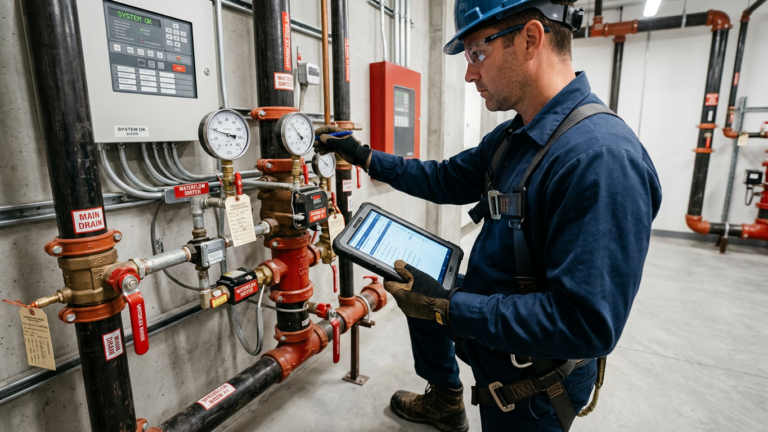
Fire Protection Inspection Services
Fire protection inspection services are one of the most important parts of keeping a building safe, compliant, and ready to respond in an emergency. If your property relies on fire sprinklers, fire alarms, fire pumps, extinguishers, standpipes, hydrants, or backflow devices, those systems need to be inspected on schedule and documented properly. Missing required inspections can lead to code issues, failed inspections, expensive repairs, liability concerns, and unnecessary risk for your occupants and property.
At Fire Sprinklers and Fire Alarms, we provide fire protection inspection services in Las Vegas, Henderson, North Las Vegas, Clark County, and Greater Southern Nevada. Our team performs quarterly, semi-annual, and annual inspections for a wide range of fire protection systems, helping property owners, managers, contractors, and facility teams stay ahead of deficiencies instead of reacting to emergencies after the fact. Request a Quote today to schedule your next inspection.
What Are Fire Protection Inspection Services?
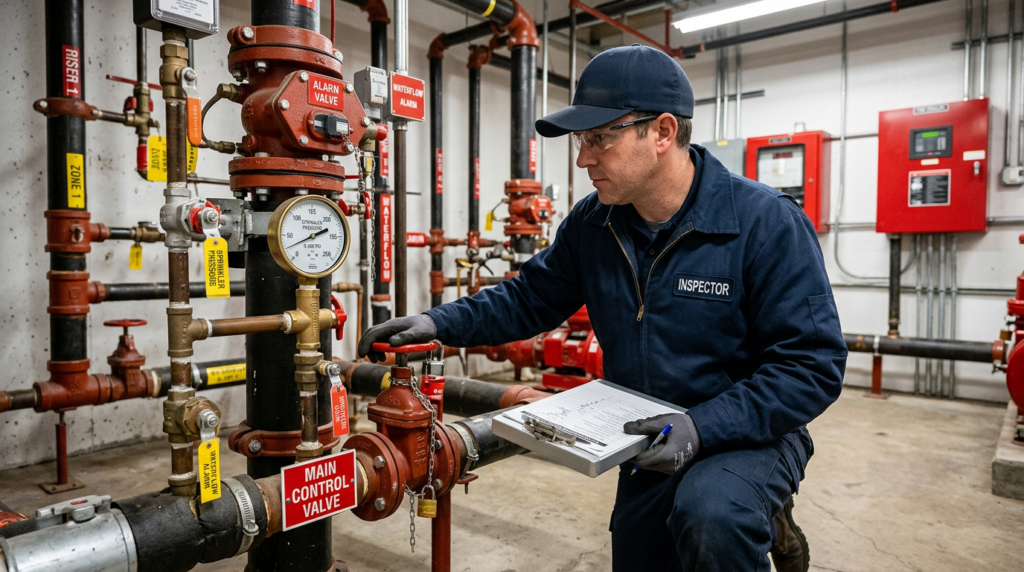
Fire protection inspection services are scheduled evaluations of life safety systems designed to confirm that equipment is present, accessible, operating correctly, and maintained in accordance with applicable requirements. These inspections are not just paperwork. They are an essential part of identifying wear, damage, tampering, obstructions, communication issues, pressure problems, alarm faults, and other conditions that can keep a fire protection system from performing when it is needed most.
For many buildings, inspections happen at different intervals because different system components require different levels of attention. Some items need frequent visual review. Others require more in-depth functional testing every six months. Annual inspections are usually the most comprehensive and can include full testing, performance verification, and detailed review of multiple fire protection systems. A reliable inspection program helps you stay organized, respond to deficiencies early, and avoid surprises during code enforcement or insurance review.
Why Regular Fire Protection Inspections Matter
Fire protection systems are not install-it-and-forget-it equipment. Over time, valves get bumped out of position, gauges drift, detectors collect dust, batteries weaken, pumps develop issues, hydrants become obstructed, and portable extinguishers lose readiness. Even a system that looked fine last year can develop conditions that affect performance today. Regular fire protection inspection services help catch those issues while they are still manageable.
These inspections also support the bigger picture of property protection. A documented inspection program can help improve life safety, reduce risk to tenants and staff, protect assets, support business continuity, and create a clear record that the building owner is taking fire protection seriously. That matters whether you manage an office building, industrial facility, retail center, warehouse, apartment complex, restaurant, medical space, educational property, or mixed-use project.
For many property owners, inspections also have a practical financial value. They can reduce the chance of unplanned shutdowns, uncover small issues before they become major repairs, extend equipment life, and support insurance and compliance expectations. In other words, inspection services are not just about checking boxes. They are about keeping your systems dependable and your property prepared.
What Is Included in Quarterly Fire Protection Inspections?
Quarterly fire protection inspections are typically focused on frequent visual checks and basic functional verification of accessible components. They help confirm that systems remain in normal condition between larger inspection cycles and that obvious issues are found quickly. On many properties, quarterly inspections are the first line of defense against unnoticed deficiencies.
Depending on the system and site conditions, quarterly inspection work can include checking fire sprinkler control valves, verifying pressure gauges, reviewing alarm and supervisory indicators, confirming water-flow alarm operation, checking hose connections, and inspecting the overall condition and accessibility of portable fire extinguishers. These visits can also reveal blocked access, damaged signage, corrosion, leaks, tampering, missing tags, or changes to the building that may affect system performance.
Quarterly fire protection inspections are especially valuable for active facilities where daily operations can create gradual changes around life safety equipment. Storage can creep too close to sprinkler risers. Walls or layouts can change around alarm devices. Access to extinguishers can become obstructed. A scheduled quarterly review helps keep those small problems from becoming major code or safety issues.
What Is Included in Semi-Annual Fire Protection Inspections?
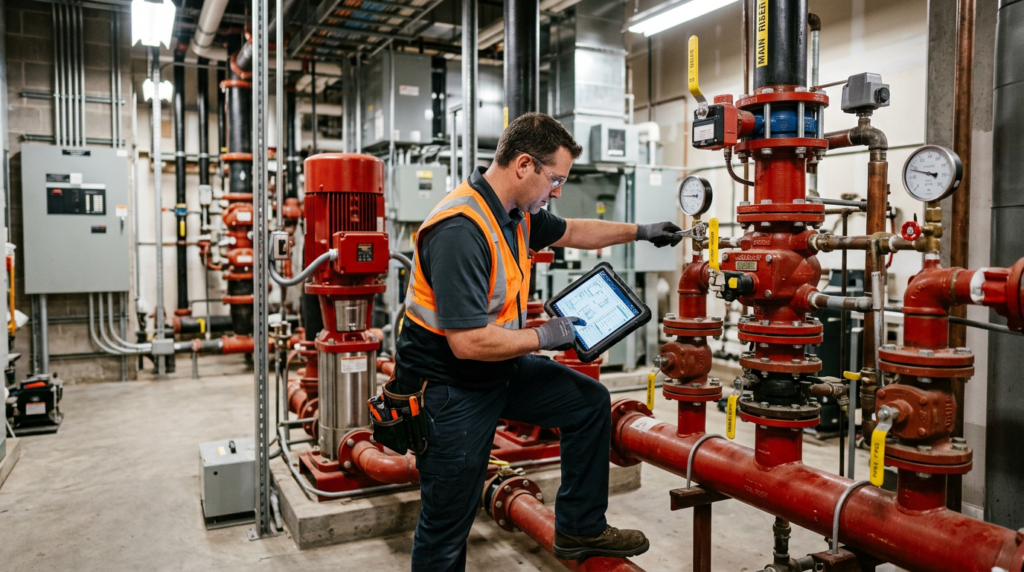
Semi-annual fire protection inspections build on the quarterly schedule by adding deeper functional verification. These inspections often involve more detailed testing of selected components and controls so that performance concerns can be identified before the annual cycle. They are an important checkpoint for properties that depend on multiple interrelated fire protection systems.
Semi-annual work may include tests for vane or pressure switches, tamper switches, pump controller functions, alarm communication features, selected initiating devices, and other equipment that benefits from a more detailed inspection frequency. Because these inspections go beyond simple visual observation, they often provide a better picture of how systems are actually operating rather than just how they appear.
For facilities with higher occupancy loads, business continuity concerns, or stricter operational requirements, semi-annual inspections add another layer of confidence. They help confirm that a property is not drifting from compliance or performance between annual evaluations. They also provide useful documentation and a clearer maintenance history for owners, managers, and compliance teams.
What Is Included in Annual Fire Protection Inspections?
Annual fire protection inspections are the most comprehensive level of routine evaluation. They are designed to review fire protection systems in much greater depth and typically involve more extensive testing of sprinklers, alarms, pumps, hydrants, backflow devices, standpipes, and extinguishers. If quarterly and semi-annual inspections help manage ongoing reliability, annual inspections help confirm overall system integrity.
Annual inspection work can include main drain testing, alarm valve testing, trip testing for dry or pre-action systems where applicable, full-flow fire pump testing, testing of initiating devices and notification appliances, and more complete review of extinguishers, hydrants, and associated equipment. The specific scope depends on the systems installed at the property, but the goal is the same: to verify that critical fire protection equipment is not only present, but functioning as intended.
Annual inspections are also where many property owners get the clearest picture of long-term trends. Repeated findings in the same area may suggest a maintenance need, operational issue, environmental condition, or aging component that should be addressed before it creates a more serious failure. When handled by an experienced fire protection company, annual inspections become more than a compliance event. They become a strategic asset for planning repairs, budgeting improvements, and protecting the building long term.
Systems We Inspect
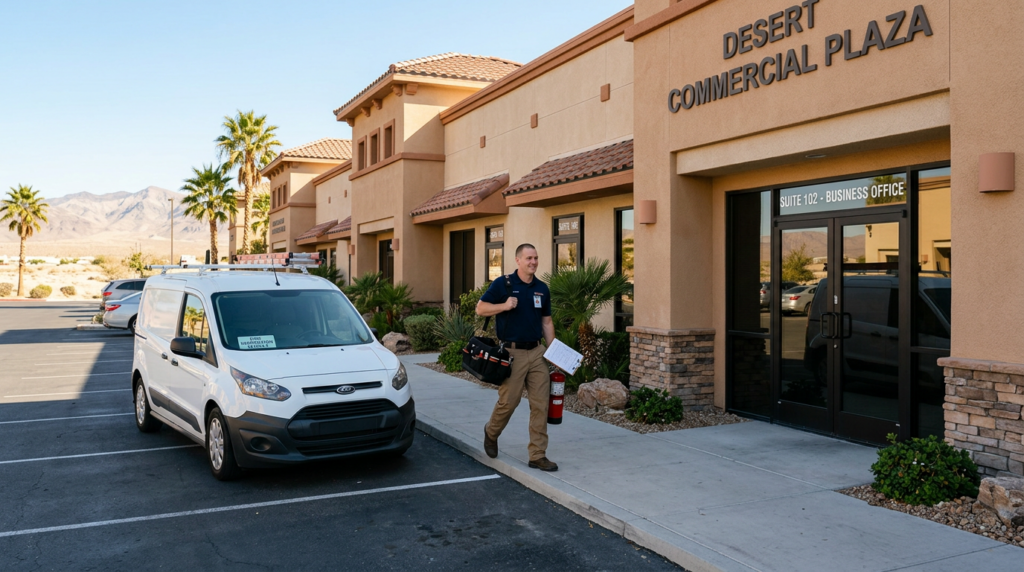
Our fire protection inspection services cover a broad range of life safety systems. If your property includes water-based suppression, detection, notification, or first-response equipment, it should be part of a documented inspection program. We inspect many of the systems commonly found across commercial, industrial, multi-tenant, institutional, and residential properties.
That includes fire sprinkler system service for wet, dry, pre-action, and related systems; fire alarm system service for detection and notification equipment; and fire pump service where maintained pressure and flow are critical to system performance. We also inspect fire extinguisher service equipment, private fire hydrant service infrastructure, and backflow preventer service assemblies as part of a complete site safety strategy.
Some properties also require standpipe evaluations and associated testing. Others may need coordination between inspections and broader maintenance needs. If deficiencies are found, those issues can be tied into a broader corrective plan through our maintenance and repair fire protection service. That means owners do not have to work with one company for inspections and another for follow-up support. We can help you manage both.
Who Needs Fire Protection Inspection Services?
Fire protection inspection services are important for almost any occupied property, but they are especially critical for commercial buildings, office suites, retail centers, restaurants, warehouses, industrial spaces, apartment communities, mixed-use developments, healthcare spaces, schools, hospitality properties, and facilities with public access. If your building has installed fire protection systems, regular inspections are part of responsible ownership and ongoing compliance.
These services are also valuable for owners and managers overseeing older buildings, recently renovated spaces, or facilities with changing occupancy conditions. A tenant improvement, expansion, change in use, or system modification can create new inspection and maintenance needs. In those cases, inspections help verify that the fire protection infrastructure still aligns with the building as it exists today, not just as it was originally designed.
If you are planning a project, inspections can also complement related services such as new construction fire protection, tenant improvement fire protection, or residential fire protection. For many properties, the strongest approach is a combination of inspection, maintenance, repair, and system planning rather than treating each need in isolation.
Common Problems Found During Inspections
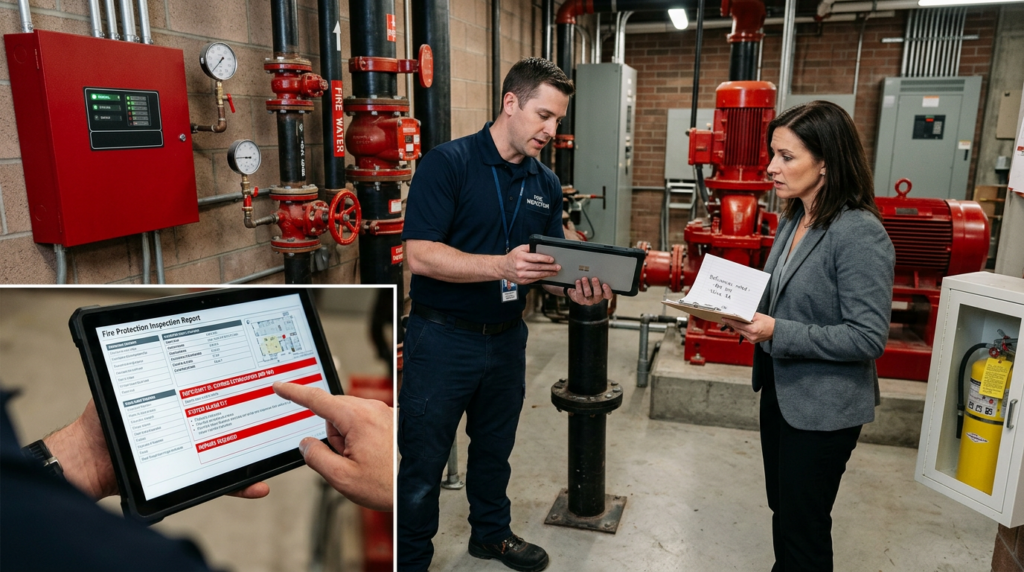
One of the biggest reasons to invest in routine fire protection inspection services is that they reveal issues that are easy to miss during normal operations. A valve can be partially closed. A gauge can read out of the expected range. An extinguisher can be missing, damaged, or blocked. A detector can be dirty or malfunctioning. A pump controller can show a trouble condition. A hydrant can be obstructed or not maintained properly. None of these issues are rare, and all of them matter.
Inspections also uncover changes caused by daily use of the property. Storage can block sprinkler discharge patterns. Remodeling can affect alarm coverage. Signage can be removed. Components can age. Tags and documentation can become incomplete. Even when the system itself has not obviously failed, surrounding conditions may reduce its readiness or complicate emergency response.
Finding these issues early gives owners options. Corrective work can be scheduled in a more controlled and cost-effective way. Repeat deficiencies can be tracked and addressed at the root cause. The result is better reliability, fewer surprises, and a stronger compliance record over time.
Our Fire Protection Inspection Process
Our inspection process is designed to be thorough, practical, and easy for property owners and managers to work with. We begin by identifying the systems present at the property and confirming the inspection frequency and scope needed for those systems. From there, we complete the appropriate quarterly, semi-annual, or annual inspection work based on the equipment installed and the condition of the site.
During the inspection, we review applicable components, document observations, identify deficiencies, and note any items that may require maintenance, repair, adjustment, or further testing. We also pay attention to accessibility, signage, visible damage, and changes in building conditions that could affect system performance. That includes not only the equipment itself, but the environment around it.
After the inspection, we provide documentation that helps owners and managers understand the current condition of the system and the next steps, if any are needed. If repairs or follow-up work are required, we can coordinate those recommendations with related services and help you move from inspection to correction without delay. The goal is not just to point out problems. The goal is to help solve them.
Why Documentation and Compliance Matter
Documented inspection history is an important part of responsible fire protection management. In many cases, it helps demonstrate that a building owner is actively maintaining required systems and responding to issues in a timely manner. That can matter during code reviews, insurance discussions, ownership transitions, and internal risk-management processes.
Fire protection inspections are also closely tied to nationally recognized standards and code expectations. The National Fire Protection Association maintains a broad body of codes and standards that influence system inspection, testing, and maintenance practices across the industry. Staying aligned with those expectations supports safer buildings and more consistent performance. NFPA Codes and Standards
For building owners, compliance is not just about avoiding a citation. It is about creating a system of accountability around life safety equipment. When inspections are skipped, deferred, or poorly documented, the risk is not only regulatory. It is operational. And in an emergency, operational readiness is what matters most.
Why Choose Pipe Fitters Fire Protection?
Choosing the right company for fire protection inspection services matters because inspections should do more than generate a checklist. They should help you understand your systems, stay organized, and keep your property prepared. Fire Sprinklers and Fire Alarms offers broad service coverage, local market knowledge, and the ability to support inspection work across multiple fire protection disciplines.
That matters for owners and managers who want one dependable partner rather than a patchwork of vendors. Whether you need recurring inspection support, a quote for a newly acquired property, or a plan to correct deficiencies found during service, we can help connect the inspection process to real next steps. You can also explore all fire protection services or view the company’s local coverage for Las Vegas, Henderson, North Las Vegas, and Clark County.
Frequently Asked Questions
What are fire protection inspection services?
Fire protection inspection services are scheduled evaluations of systems such as sprinklers, alarms, pumps, extinguishers, standpipes, hydrants, and backflow devices to help verify compliance, condition, and readiness.
What is included in quarterly fire protection inspections?
Quarterly inspections generally focus on visual checks and basic functional review of accessible components such as valves, gauges, alarms, hose connections, and extinguisher condition.
How are semi-annual inspections different from annual inspections?
Semi-annual inspections add deeper functional testing beyond quarterly checks, while annual inspections are typically the most comprehensive and can include broader system testing and performance verification.
Why are regular fire protection inspections important?
They help protect life and property, support code compliance, reduce unexpected failures, improve documentation, and uncover deficiencies before they turn into larger problems.
Do you provide fire protection inspection services in Las Vegas and nearby areas?
Yes. We serve Las Vegas, Henderson, North Las Vegas, Clark County, and Greater Southern Nevada.
Request a Quote for Fire Protection Inspection Services
If you need quarterly, semi-annual, or annual fire protection inspection services, Fire Sprinklers and Fire Alarms is ready to help. We work with property owners, managers, contractors, and facilities that need reliable inspection scheduling, clear documentation, and support for ongoing system readiness.
Need Fire Protection Services?
Request a Quote
Call 702-FITTERS (702-348-8377)
Learn More